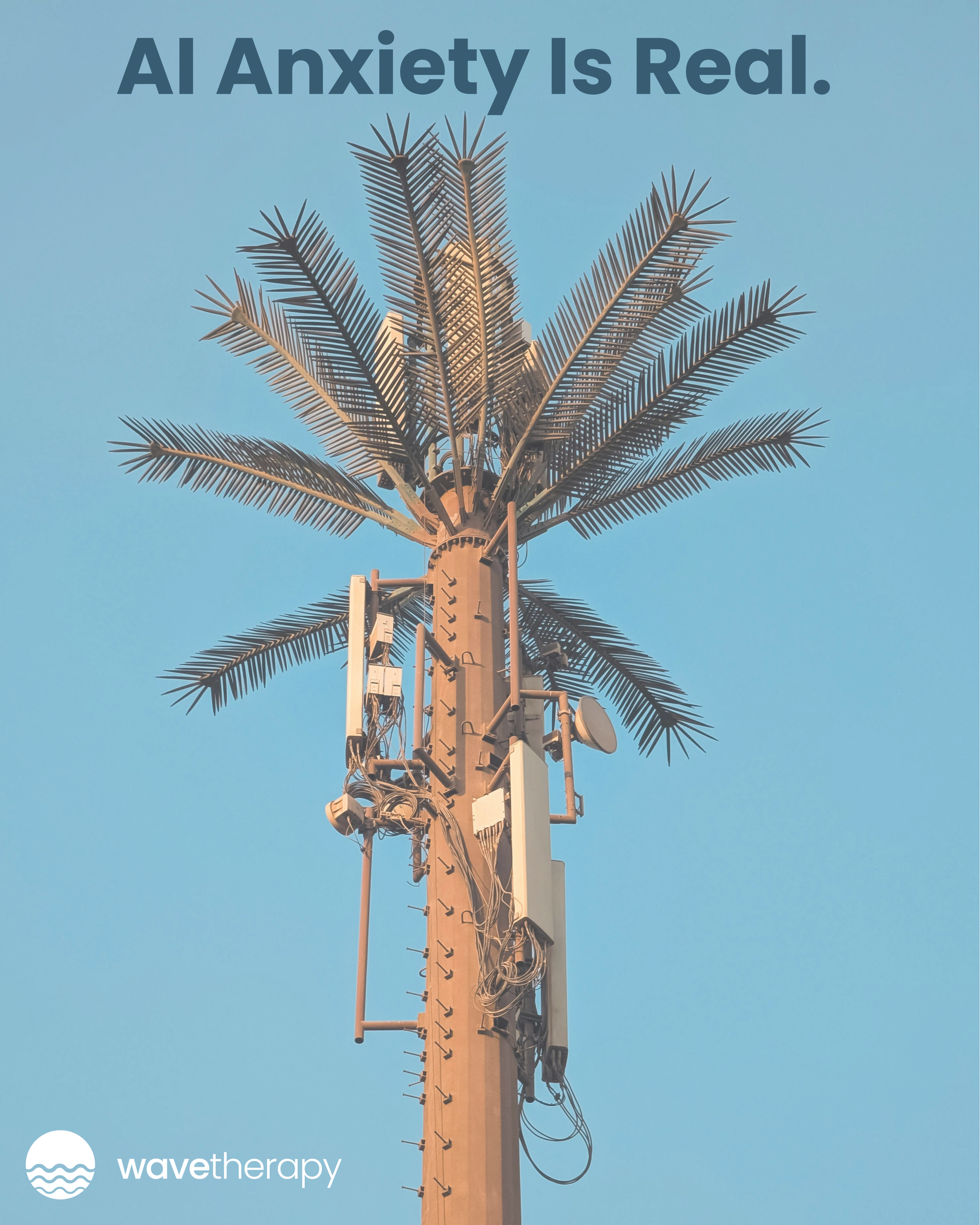
AI Anxiety Is Real. Here's What It Actually Looks Like for Career-Driven Men.
You're good at your job. Maybe great at it. You've spent a decade, maybe two, building expertise, earning trust, climbing. You've got the title, the comp, the reputation. People come to you for answers.
And now, quietly, in the back of your mind, there's a voice that won't shut up:
What if none of that matters in two years?
You're not saying this out loud. Not to your manager. Not to your partner. Definitely not to your team. You're the one who's supposed to have it figured out. You've always been the one who adapts, who learns fast, who stays ahead of the curve.
But this doesn't feel like a curve. It feels like a cliff.
This Is Not a Technology Problem. It's an Identity Crisis.
Here's what most of the "how to thrive in the age of AI" articles miss entirely: the anxiety you're feeling isn't really about AI. It's about what your career means to you, and what happens to you if that meaning gets taken away.
For career-driven people, work isn't just a paycheck. It's proof. Proof that you're smart. Proof that you're valuable. Proof that the sacrifices, the late nights, the missed dinners, the years of grinding, were worth something. Your career is the scaffold your entire self-concept is built on.
So when an AI tool can now do in four seconds what used to take you four hours... the analysis you were known for, the strategy doc that made you indispensable, the code that was your fingerprint. It doesn't just feel like a workflow change. It feels like an existential threat. Because if the thing you do can be automated, then what, exactly, are you?
That's not a productivity question. That's an identity question.
What AI Anxiety Actually Looks Like (It's Not What You Think)
Most people won't say "I'm anxious about AI." That's too vulnerable, too on-the-nose. Instead, it shows up sideways.
It looks like overworking. You're putting in more hours than ever. Not because the work demands it, but because you need to prove (to yourself, mostly) that you're still necessary. You're outrunning a machine by just running faster. It's not sustainable, and somewhere in your body, you already know that.
It looks like cynicism. You've become the person in meetings who rolls their eyes at AI initiatives. "It's just hype." "It can't do what we do." The dismissiveness feels like confidence, but underneath it there's fear you don't want to examine.
It looks like obsessive upskilling. You've enrolled in three AI courses, you're watching YouTube tutorials at 2x speed, you're trying to learn Python on weekends. Not because you're excited, but because you're terrified of being caught without the right credential when the axe falls. Learning has become a defense mechanism instead of curiosity.
It looks like decision paralysis. Should you double down on your current career? Pivot completely? Start a side business? Go back to school? You've been thinking about this for months and you haven't done anything, because every option feels like a bet you might lose.
It looks like irritability at home. Your partner asks how your day was and you snap. Your kids want your attention and you're mentally somewhere else, running scenarios, calculating how many years you have left before your role gets "restructured." You're physically present and psychologically absent.
It looks like insomnia. You're lying awake at 2 AM reading articles about which jobs AI will eliminate. You fall asleep with your phone in your hand. You wake up tired and spend the first hour of the day scrolling for more evidence that you should be afraid.
If you recognized yourself in any of that, or all of it, you're not weak. You're human. And you're having a perfectly rational response to a genuinely destabilizing situation. This is high-functioning anxiety, and it deserves real attention.
Why Career-Driven Men Are Especially Vulnerable
I work primarily with career-driven men, and I want to name something that rarely gets said plainly: many men have been socialized to build their entire identity around professional competence. Not relationships. Not emotional depth. Not community. Competence.
The unspoken deal goes something like this: if you work hard enough, if you're smart enough, if you deliver results, you'll be safe. You'll be respected. You'll be worthy.
AI breaks that deal.
Not because AI is actually replacing you. Most people reading this will still have their jobs next year. But because it introduces uncertainty into the one area of life where you felt certain. And for someone who's staked everything on professional identity, uncertainty in your career doesn't just feel uncomfortable. It feels like the ground is gone.
This is why the standard advice, "just learn to use AI as a tool," lands so flat. It's technically correct and emotionally useless. It's like telling someone who's afraid of flying to just "think about the physics of lift." The fear isn't irrational. It's just operating on a different level than the advice.
The Conversations I'm Having That You're Not Having
In my therapy practice, I sit with career-driven men every week who are navigating some version of this. And I can tell you: you are not the only one feeling this way. Not even close.
I'm hearing from senior engineers who've been in the industry for 15 years and are quietly wondering if they should have gone into healthcare instead. I'm hearing from product managers who used to feel like the smartest person in the room and now feel like they're faking it every single day. I'm hearing from founders who built companies on expertise that AI is commoditizing in real time.
These are accomplished, intelligent, high-performing people. And they're scared.
The difference between the ones who get stuck and the ones who move through it isn't intelligence or adaptability. It's whether they have a space to actually say the thing out loud: I don't know who I am if I'm not the best at this.
That's the sentence underneath all of it. And it's a sentence most career-driven men have never said to anyone, including themselves.
What Actually Helps (It's Not Another AI Course)
I'm not going to tell you AI anxiety is irrational. It's not. The labor market is shifting. Roles are changing. Some jobs will look dramatically different in five years. Pretending otherwise would be dishonest.
But here's what I know from sitting with people who are in the thick of this: the anxiety becomes unmanageable when your entire sense of self is dependent on one thing. Your professional output. When that's the case, any threat to your career is a threat to your identity, and your nervous system responds accordingly.
The work isn't about becoming an AI expert. The work is about building an identity that's wider than your job title.
That means asking questions most high performers have been avoiding for years:
Who are you when you're not producing? If you can't answer that, or if the answer makes you uncomfortable, that's important information. It means your identity has become dangerously narrow, and AI is just the thing that's making that visible.
What would you do if your current role disappeared tomorrow? Not "what job would you get," but what would you do? How would you spend your time? Who would you be? If the honest answer is "I have no idea," you've found the real problem. And it predates AI.
When was the last time you felt valuable outside of a work context? As a partner, a parent, a friend, a human being who exists in the world. If you have to think about it for a long time, that's the gap that needs attention.
Are you making career decisions from clarity or from fear? The obsessive upskilling, the constant job searching, the frantic networking... is it strategic, or is it anxiety wearing a productivity costume? There's a big difference, and most people can't tell which one they're doing without someone helping them see it.
You Don't Need a Five-Year Plan. You Need an Honest Conversation.
The most useful thing you can do right now isn't signing up for another AI certification. It's having a real conversation with a therapist, a coach, a trusted friend, about what's actually going on underneath the career anxiety.
Because here's the thing about AI anxiety: the people who navigate it well aren't the ones who become AI experts fastest. They're the ones who figure out that their worth was never actually about the work in the first place. That's not a soft, motivational poster insight. It's a genuinely difficult psychological shift, and most people need help making it.
I built my practice specifically for career-driven men navigating this kind of thing. Not because I read about it in a textbook, but because I've lived in that world. I spent years in the startup ecosystem. I've sat across the table from VCs. I've felt the exact pressure of tying my identity to what I could build and ship and sell. And I've done the work of untangling that.
If any of this resonated, if you read it and felt a knot in your stomach, that's worth paying attention to.
You don't have to have it all figured out before you reach out. In fact, the people who benefit most are the ones who show up and say, "I don't even know what I need. I just know something's off."
That's more than enough to start.
If you're ready to start navigating the identity shift that AI is forcing, book a free consultation.